
Please click on the forms below for a downloadable PDF document.
SUMMER HORSE FORMS:
2026 Summer Horses are now on a waitlist! Please contact our office for availability.
2027 Summer Horse rental forms coming in January 2027!
GREAT AMERICAN HORSE DRIVE FORMS:
HUNTING HORSE FORMS:
LIABILITY WAIVERS:
RELEASE_OF_LIABILITY_AND_INDEMNITY_AGREEMENT_ADULT_18_AND_OVER


SOMBRERO RANCHES, INC./COLORADO HORSES, INC.
HAS BEEN IN MULTIPLE COMMERCIAL PRODUCTIONS
- Boot Barn
- Western Horseman
- Frontier Magazine
- Lydia’s Style Magazine
- Craig Daily Press
- Sunday Reporter
- The Furrow
- Daily Times Call
- Paint Horse Journal
- Denver Post
- Empire Magazine
- Appaloosa Journal
- Saturday Northwest
- Colorado Critters
- Successful Farming
- Lefthand Valley Courier
- Cowboys & Indians
- Horse & Rider
- Steamboat Magazine
- The Fence Post
- Return to Lonesome Dove
- Centennial
- Lightning Jack
- Conagher
- Dumb and Dumber
- Comanche Moon
- Cowboys & Aliens
- The Lone Ranger
- A Million Ways to Die In the West
- GQ Magazine
- Marlboro
- Kerr McGee Gas Company
- Colorado Saddlery
- Wrangler
- Ford Motor Company
- KIA
- Copenhagen U.S. Tobacco Company
- People Magazine
- Avenging Angels
- Tony Lama
And Many More On The Way!
FREQUENTLY ASKED QUESTIONS
What kind of bedding should I bring?
What kind of clothes should I pack?
What should I expect for accommodations?
What if I have a specialized diet?
What kind of food will be served?
Do we camp out with the horses at the halfway point?
How many miles do we ride?
May I bring my own horse?
May I bring my own saddle?
May I ship my saddle?
Is there a weight limit to ride the horses?
Are gratuities appropriate?
Where are you located, and do you provide transportation?
Address of the airport: 11005 Cty Rd 51A, Hayden, CO 81639
Will we ride if it is raining? What about snowing?
Is there an age limit for the drive?
Do I have to shoe my horses in the summer?
What do I do if my horse needs veterinary care?
How do I return my horses?
How do I return my rental horses if I am out of state?
Am I responsible for any injury to horse or damage to equipment during my lease term?
Can I extend my summer lease into the fall season?
Can I use my own equipment/saddle on my lease horse?
Will horses load in a two-horse trailer for transporting?
How long can I lease a horse for?
What do I do when I am done with my rental horses?
How long will it take for my horses to arrive or be picked up?
Why can’t I have my horses before 11 am?
What if my horse throws a shoe during my rental?
What do I do if I have an emergency and need to return my horses early?
Am I able to leave my horses at a designated spot for Sombrero to pick up when I have completed my hunt?
What is a drop camp?
What is a game management unit GMU?
How do I apply for a hunting license?
HORSE FEEDING AND CARE RECOMMENDATIONS
Planning a Better Trip for You and Your Horse!
- FEEDING
A horse requires at least twenty-five (25) pounds of quality hay per day. As a company policy, we also recommend that you feed six (6) pounds of grain per day. This ensure the horses are full and they have enough energy to last the day. When feeding, each horse will need their own separate serving of hay to prevent fighting and possible injury. Bigger horses require more feed. If you have a large draft-size animal, they need at minimum thirty (30) pounds of quality hay. - Important things to know:
- BLM, Wilderness, and National Forest Service all require certified weed-free hay.
- Wilderness lands DO NOT allow bales of hay to be brought in, only cubed feed.
USE CAUTION WITH PELLETS AND CUBED FEED. WE DO NOT RECOMMEND PELLETIZED FEED.
- FEEDING CUBED AND PELLETIZED FEED
Cubed and pelleted feeds can be used if they are soaked in water for at least an hour, prior to feeding. This does require the use of a bucket or water-holding device, as well as easy access to water. To know how much to feed each horse, read the manufacturer’s instructions on the packaging. The average horse weighs 1,000 pounds, with draft-size horses reaching 1,400 pounds. Horses must be fed twice a day, and cubes or pellets must be rehydrated prior to every feeding. - WATERING
A horse MUST be watered at least three (3) times per day, and more often if you are using them. Horses refusing to drink should be monitored carefully and given more opportunities to drink. The key to keeping your horses healthy during your trip is to ensure they have access to clean water often. - SADDLING
It is important to saddle your horse properly not only for the safety of the horse, but your safety as well.

First, the horse should be assessed for how dirty he/she is; leaving mud, leaves, or foreign objects on their backs while they are saddled can lead to soring and even misbehavior! Once their backs have been cleaned, check the blanket and pad to ensure they have not fallen in the dirt. Place the blanket closest to the horse’s skin and the thicker pad on top. The front fold of the blanket should be in line with the horse’s shoulder. The pad and blanket have a natural tendency to move backwards throughout the day, so be sure to keep an eye on it and adjust as necessary.
Next, the saddle and cinch should be inspected for dirt, twigs, etc. that are stuck in the cinch. The saddle should be placed just behind the front shoulder. The cinch should go under the horse’s belly, from right to left, and attach on the left side (or driver’s side). The cinch should sit just behind the front armpits of the horse, but not rub them.
The latigo should be tightened where it is comfortable, but not painful for the horse. A good way to measure if it is tight enough is by sliding your fingers between the horse’s body and cinch. If you are still able to get your fingers between them, then it is suitable.
Bridling is not always the easiest task, but if you treat the horses gently and avoid fighting them, you will find it is easier than you think. For a complete tutorial on how to properly bridle a horse, please follow this link: https://www.youtube.com/watch?v=yWTIxh9eURE
TO AVOID SADDLE SORES OR SORING
Please follow the guidelines below to help prevent soring in your horse:
Do not over-pack, ride double, or ride and pack horses at the same time. Overworking horses will cause soring, lameness, and in some cases colic.
Use both the saddle pad and blanket provided for you during your rental. Be mindful that the equipment stays in the proper location throughout the day. More importantly, ensure that your saddle is not rubbing on the horse’s withers, armpits, or back.
Proper adjustment of the cinch will reduce the risk of cinch soring. For guidance on the tightness of a cinch, see the section on saddling your horse. Balance your weight on the horse’s back evenly. Ensure that your stirrups are the same length and you are centered in the horse’s back.

PACKING HORSES, LOADING AND HAULING GEAR ON HORSEBACK
DO NOT PACK MORE THAN TWO HUNDRED (200) POUNDS PER HORSE.
This means one hundred (100) pounds per side. When using panniers, make sure the saddle has been adjusted properly, and both the pad and blanket are in the correct spot. Pack the panniers with the heaviest objects on the bottom, and fill the tops with the lightest objects.
DO NOT put sharp objects in the panniers; this includes, but is not limited to: unsheathed knives and axes, antlers, and hanging forks. Should a horse accidentally slip on a trail, sharp objects can puncture saddle panniers and injure the horse.
DO NOT pack an entire elk, deer, or antelope on a single horse at ANY time. A horse can carry two hindquarters OR two front quarters and back strap, at one time.

NIGHT TIME PROCEDURES
EVERY night, horses must be unsaddled and unbridled. Your horse may ONLY have a halter on at night to ensure they receive optimal rest. Upon returning to camp, your horse must be watered promptly. Allow adequate time for the horse to drink to contentment. Some horses feel vulnerable drinking water in a new location; be patient, and allow them to have multiple attempts at water as they adapt to their surroundings. The next priority is ensuring horses get enough to eat. If you are feeding pelletized or cubed hay, it must have soaked in water at least an hour prior to feeding. Cubes, pellets, and hay should all be separated into multiple piles to prevent fighting. CAUTION SHOULD BE USED WHEN FEEDING PELLETS, AS THEY CAN CAUSE CHOKING.
- EACH NIGHT
Check your horse’s back for hot spots, sores, or rub marks on their back, withers, and over their kidneys. If a horse has begun to develop any AREAS OF CONCERN, immediately discontinue use, as these can take weeks to heal. - CONTAINING HORSES AT NIGHT
The National Forest Service, BLM, and Wilderness areas require the use of high-lines for tying horses. Information on this can be found in the “Back Country Horsemen of America Guidebook.” When tying your horses, use a quick-release slip knot. This ensures that if an incident happens, you can easily release the horse from the tie. Tie your horse short enough that it is unable to step over the lead rope or get tangled up with others, but long enough to be able to rest its head and make small movements.
We recommend that when feeding horses on the ground, lengthen their lead ropes until they are finished eating, then before evening shorten the lead ropes again.
DO NOT tie horses to fallen dead trees, that if spooked they could drag or move.
DO NOT tie horses under or to trees that could fall if pulled, or in strong winds.
DO NOT tie horses to vehicles, camping equipment such as a tent, the ground or any other unsecured, breakable, or dangerous objects.
- TRAILERING
Our horses are not trained to load in a straight load or small trailers, such as two-horse trailers. If you plan on picking up your horses and hauling, please provide a larger stock trailer.When unloading your horse, always untie them before opening the trailer door. Allow the horses to back off the trailer and take their time stepping down from the elevated deck

When loading the horses, do not use constant pressure when leading. It is a give-and-take relationship. Face them towards the trailer, give a small tug, then release. Do not fight them; few can win a tug-of-war against a 1,200-pound animal.
DO NOT leave a horse in the trailer overnight.
DO NOT travel for longer than eight hours without unloading the horse and giving them the chance to rest and eat.
- GENERAL INFORMATION
Please take the time to get to know the rental horses that will be under your care by asking our staff any questions that you may have. The best time to do this is when your horses are dropped off, or if you come to pick them up. - EMERGENCY PLAN
IN CASE OF NATURAL DISASTER, PHYSICAL HARM, OR OTHER LIFE-THREATENING EMERGENCIES, call 911.To arrange for return of your horses: Call the Sombrero phone number on your contract to notify that a horse pickup is needed. Return the horse to the location where it was dropped off. STAY with the horse until Sombrero Ranches, Inc. arrives.
- HOW TO RESERVE YOUR HORSES
To reserve your horses, we must receive a completed contract and deposit. Please download the hunting horse rental contract at: www.sombrerohorses.com/hunting-horse
HUNTING HORSE RENTAL DATES DEPEND ON THE HUNTING SEASON
Please call for pricing: (303) 442-0258
HUNTING HORSE DEPOSITS
One or Two Horses: $500.00 total
Three Horses: $600.00 total
Four Horses: $700.00 total
Five Horses: $800.00 total
Out-of-state or board barn rentals require health papers and brand inspection
A ten- to fourteen-day prior notice is required. $100.00***
***This is a legal requirement if the horse is taken outside Colorado.
The renter is responsible for furnishing return health papers through a local veterinarian.
MULTIPLE-SEASON RENTAL RATES, AVAILABLE TO OUTFITTERS ONLY:
***Outfitters MUST Provide a Copy of a Colorado Outfitter’s License Before Rental***
Please call for pricing: (303) 442-0258
All Season Rentals: Archery, Muzzleloading, and Rifle Seasons
WHAT COMES WITH MY RENTAL?
All horses come with the tack necessary to ride western style: western saddle, bridle, halter and lead rope, pad, and blanket. We do NOT supply pack saddles, wide stirrups, rifle scabbards, saddle panniers, high-lines, breast collars, water buckets, feed buckets, horse brushes, or any additional specialty items. These items are the responsibility of the RENTER, should they be needed. Hay and grain are available for purchase and will be brought upon delivery of your horses. If you purchase feed from an outside source, you MUST show proof of feed. NO refunds will be issued for any unused hay or grain.
FEED COSTS THROUGH SOMBRERO RANCHES, INC. (SUBJECT TO CHANGE WITHOUT NOTICE)
Certified, Weed-Free Hay Bale (approx. 50 lbs each): $25.00 per bale*
Sweet-Mix Grain: $20.00 per bag*
*Feed delivery offered while supplies last
- DELIVERY POLICY: No deliveries or pickups will be made the weekend of Labor Day
Sombrero Ranches, Inc. will deliver and pick up your horses one time, for a fuel fee of 7% of the total delivery cost. Additional delivery, pickup, or exchanges will be charged and automatically withheld from your deposit. Please see our delivery locations and price list. We do NOT guarantee a delivery before 11:00 a.m., and should you require the horses earlier than 11 a.m., please plan to arrive the day before to receive your horses. If you pick up your horses, we offer more flexibility with timing, and we will schedule your pickup time with the submission of your contract. Please note that Sombrero Ranches, Inc. acknowledges that weather, travel, and horse-related occurrences happen, and renters could wait up to twelve hours for pickup and delivery of rental horses.
All delivery locations are subject to change depending on weather conditions and availability to get to the location with a pickup and trailer.
—We no longer deliver to Kremmling, Steamboat, Toponas, Dotsero, Gypsum, Sweetwater, Coffeepot, Grieves, or Walden.—
- DEPOSIT POLICY:
Any refundable deposits will be mailed after the close of all hunting seasons, approximately the end of December. If you leave your horses unattended, you AUTOMATICALLY forfeit all deposit monies. You must be present at both delivery and pickup of your rental horses. Deposits will also be automatically forfeited for cancellations less than fifteen days before the delivery date.
- PAYMENT POLICY:
All contracts must be paid in full to the office prior to delivery of horses or if you pick up horses.

For more information, please contact:
info@sombrero.com
Sombrero Ranches, Inc.
(Business Office Only)
911 Kimbark Street
Longmont, CO 80501
(303) 442-0258
HORSE FEEDING AND CARE RECOMMENDATIONS
Planning a Better Trip for You and Your Horse!
- FEEDING
A horse requires at least thirty (30) pounds of quality hay per day. As a company policy, we also recommend that you feed six (6) pounds of grain per day. This ensures the horses are full and have enough energy to last the day. When feeding, each horse will need their own separate serving of hay to prevent fighting and possible injury. Bigger horses require more feed. If you have a large draft-size animal, they need at minimum thirty-five (35) pounds of quality hay. - Important things to know:
- BLM, Wilderness, and National Forest Service all require certified weed-free hay.
- Wilderness lands DO NOT allow bales of hay to be brought in, only cubed feed.
USE CAUTION WITH PELLETS AND CUBED FEED. WE DO NOT RECOMMEND PELLETED FEED. CHOKING HAZARD.
- FEEDING CUBED AND PELLETIZED FEED
Cubed and pelleted feeds can be used if they are soaked in water for at least an hour prior to feeding. This does require the use of a bucket or water-holding device, as well as easy access to water. To know how much to feed each horse, read the manufacturer’s instructions on the packaging. The average horse weighs 1000 pounds, with draft-size horses reaching 1400 pounds. Horses must be fed twice a day, and cubes or pellets must be rehydrated prior to every feeding. - WATERING
A horse MUST be watered at least three (3) times per day, and more often if you are using them. Horses refusing to drink should be monitored carefully and given more opportunities to drink. The key to keeping your horses healthy during your trip is to ensure they have access to clean water often. - SADDLING
It is important to saddle your horse properly not only for the safety of the horse, but your safety as well.
First, the horse should be assessed for how dirty he/she is; leaving mud, leaves, or foreign objects on their backs while they are saddled can lead to soring and even misbehavior! Once their backs have been cleaned, check the blanket and pad to ensure they have not fallen in the dirt. Place the blanket closest to the horse’s skin and the thicker pad on top. The front fold of the blanket should be in line with the horse’s shoulder. The pad and blanket have a natural tendency to move backwards throughout the day, so be sure to keep an eye on it and adjust as necessary.
Next, the saddle and cinch should be inspected for dirt, twigs, etc. that are stuck in the cinch. The saddle should be placed just behind the front shoulder. The cinch should go under the horse’s belly, from right to left, and attach on the left side (or driver’s side). The cinch should sit just behind the front armpits of the horse, but not rub them.
The latigo should be tightened where it is comfortable, but not painful for the horse. A good way to measure if it is tight enough is by sliding your fingers between the horse’s body and cinch. If you are still able to get your fingers between them, then it is suitable.
Bridling is not always the easiest task, but if you treat the horses gently and avoid fighting them, you will find it is easier than you think. For a complete tutorial on how to properly bridle a horse, please follow this link: https://www.youtube.com/watch?v=yWTIxh9eURE.
TO AVOID SADDLE SORES OR SORING
Please follow the guidelines below to help prevent soring in your horse:
Do not over-pack, ride double, or ride and pack horses at the same time. Overworking horses will cause soring, lameness, and in some cases colic.
Use both the saddle pad and blanket provided for you during your rental. Be mindful that the equipment stays in the proper location throughout the day. More importantly, ensure that your saddle is not rubbing on the horse’s withers, armpits, or back.
Proper adjustment of the cinch will reduce the risk of cinch soring. For guidance on the tightness of a cinch, see the section on saddling your horse. Balance your weight on the horse’s back evenly. Ensure that your stirrups are the same length and you are centered in the horse’s back.
When using saddle panniers, carefully balance the load to make sure it is even. Uneven loads will lean to one side, causing rubbing and soring.
PACKING HORSES, LOADING AND HAULING GEAR ON HORSEBACK
DO NOT PACK MORE THAN TWO HUNDRED (200) POUNDS PER HORSE.
This means one hundred (100) pounds per side. When using panniers, make sure the saddle has been adjusted properly, and both the pad and blanket are in the correct spot. Pack the panniers with the heaviest objects on the bottom, and fill the tops with the lightest objects.
DO NOT put sharp objects in the panniers; this includes, but is not limited to: unsheathed knives and axes, antlers, and hanging forks. Should a horse accidentally slip on a trail, sharp objects can puncture saddle panniers and injure the horse.
DO NOT pack an entire elk, deer, or antelope on a single horse at ANY time. A horse can carry two hind quarters OR two front quarters and a back strap at one time.
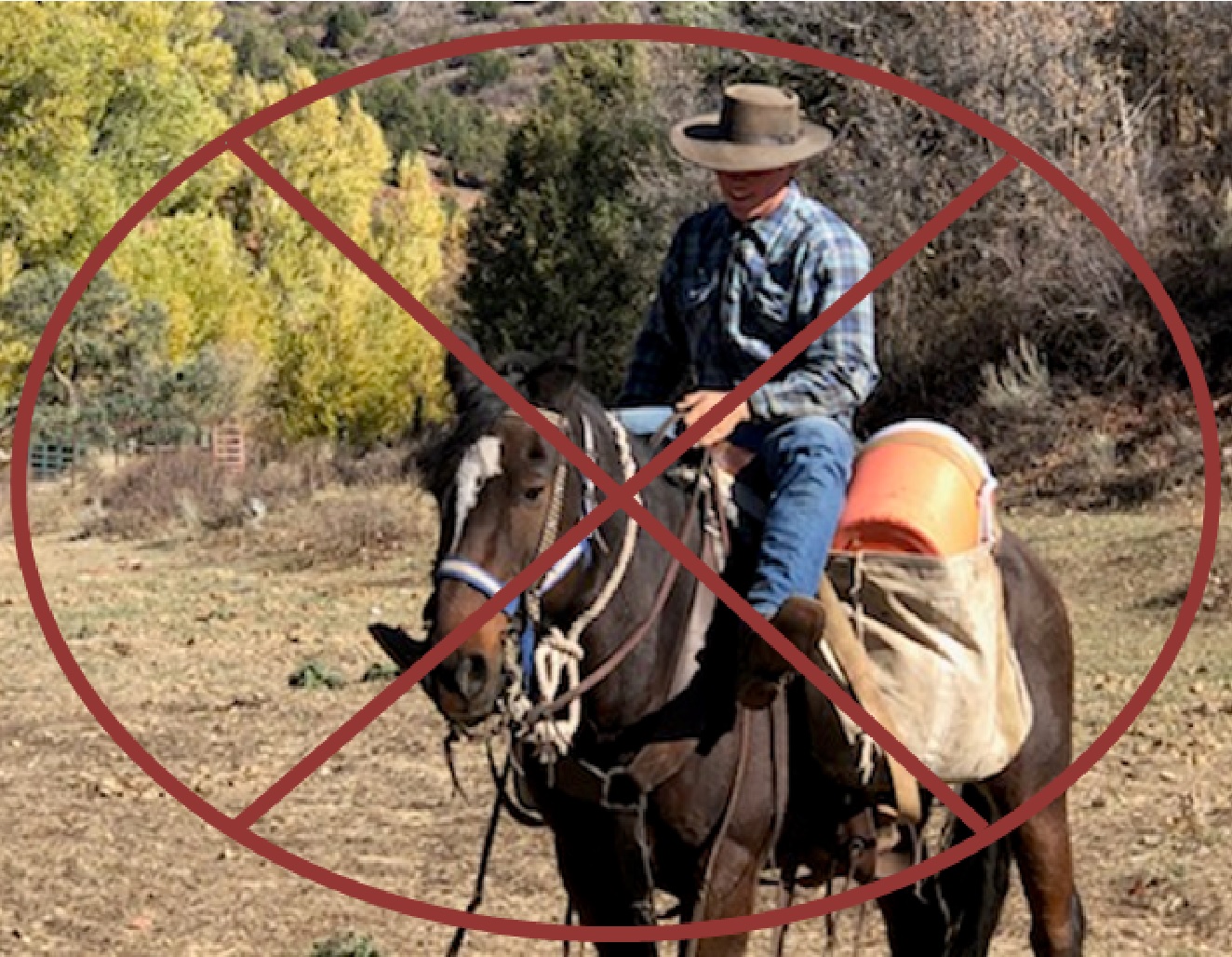
Below are the proper packing and riding techniques permitted within the confines of the contract.
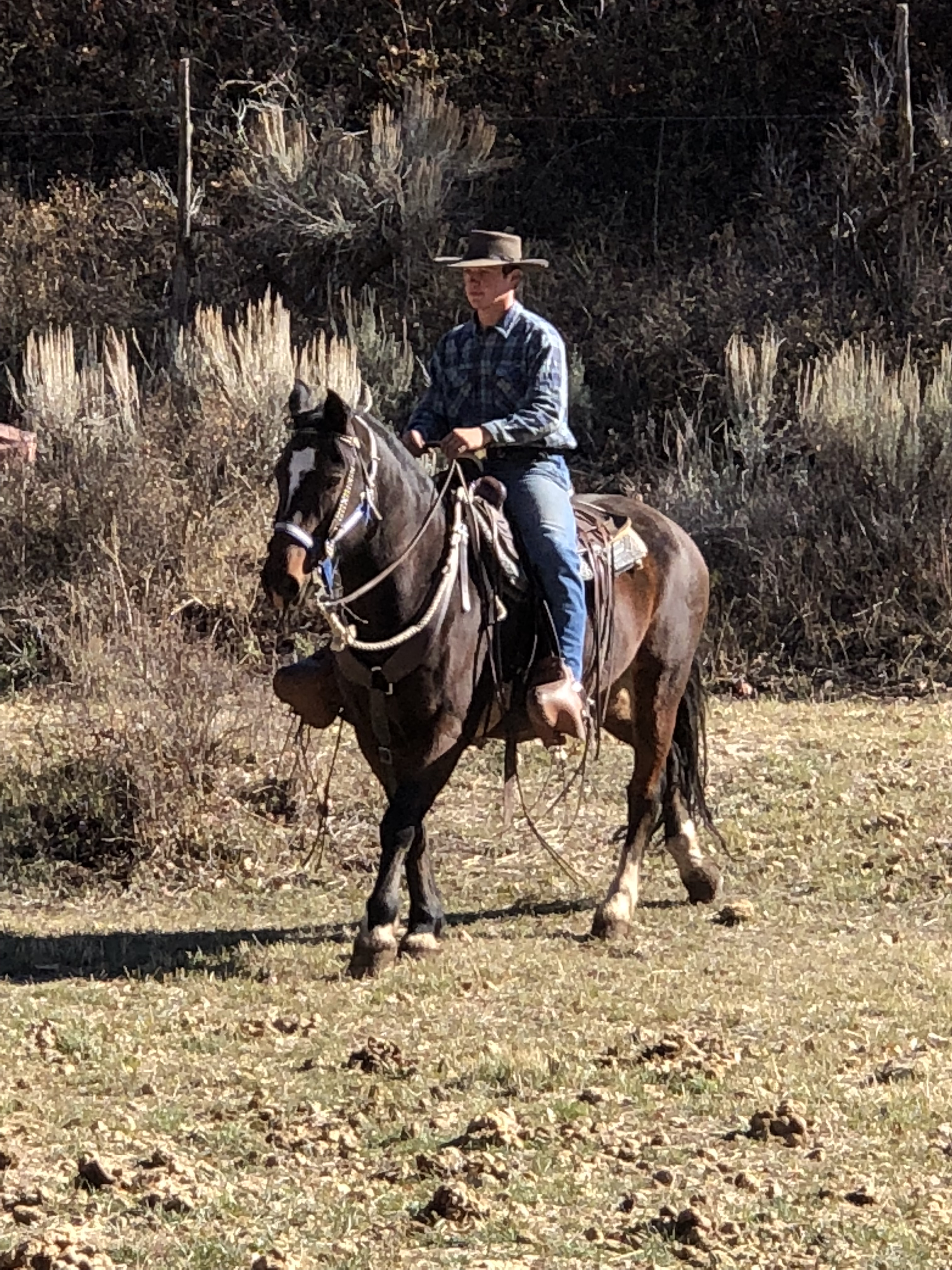

The photo to the right demonstrates an example of riding and packing at the same time; riding and packing at the same time is NOT PERMITTED. Renters found riding and packing at the same time will pay, at minimum, the cost of the rental deposit and will not be allowed to rent horses in the future.


NIGHT TIME PROCEDURES
EVERY night, horses must be unsaddled and unbridled. Your horse may ONLY have a halter on at night, to ensure they receive optimal rest. Upon returning to camp, your horse must be watered promptly. Allow adequate time for the horse to drink to contentment. Some horses feel vulnerable drinking water in a new location; be patient, and allow them to have multiple attempts at water as they adapt to their surroundings. The next priority is ensuring horses get enough to eat. If you are feeding pelletized or cubed hay, it must have soaked in water at least an hour prior to feeding. Cubes, pellets, and hay should all be separated into multiple piles to prevent fighting.
CAUTION SHOULD BE USED WHEN FEEDING PELLETS, AS THEY CAN CAUSE CHOKING.
- EACH NIGHT
Check your horse’s back for hot spots, sores, or rub marks on their back, withers, and over their kidneys. If a horse has started to develop any AREAS OF CONCERN, immediately discontinue use, as these can take weeks to heal. - CONTAINING HORSES AT NIGHT
The National Forest Service, BLM, and Wilderness areas require the use of high-lines for tying horses. Information on this can be found in the “Back Country Horsemen of America Guidebook.” When tying your horses, use a quick-release slip knot. This ensures that if an incident happens, you can easily release the horse from the tie. Tie your horse short enough that it is unable to step over the lead rope or get tangled up with others, but long enough to be able to rest its head and make small movements. Make sure the halter is secure on the horse’s head, but not so tight that it will cause sores on the horse.
We recommend that when feeding horses on the ground, lengthen their lead ropes until they are finished eating, then shorten the lead ropes again.
DO NOT tie horses to fallen dead trees, as if spooked, they could drag or move.
DO NOT tie horses under or to trees that could fall if pulled, or in strong winds.
DO NOT tie horses to vehicles, camping equipment such as a tent, the ground, or any other unsecured, breakable, or dangerous objects.
- TRAILERING
Our horses are not trained to load in a straight load or small trailers, such as two-horse trailers. If you plan on picking up your horses and hauling, please provide a larger stock trailer.When unloading your horse, always untie them before opening the trailer door. Allow the horses to back off the trailer and take their time stepping down from the elevated deck.
When loading the horses, do not use constant pressure when leading. It is a give-and-take relationship. Face them towards the trailer, give a small tug, then release. Do not fight them; few can win a tug-of-war against a 1,200-pound animal.
DO NOT leave a horse in the trailer overnight.
DO NOT travel for longer than eight hours without unloading the horse and giving them the chance to rest and eat.
- GENERAL INFORMATION
Please take the time to get to know the rental horses that will be under your care by asking our staff any questions that you may have. The best time to do this is when your horses are dropped off, or if you come to pick them up. - EMERGENCY PLAN
IN CASE OF NATURAL DISASTER, PHYSICAL HARM, OR OTHER LIFE-THREATENING EMERGENCIES, call 911.To arrange for return of your horses: Call the Sombrero phone number on your contract to notify that a horse pickup is needed. Return the horse to the location where it was dropped off. STAY with the horse until Sombrero Ranches, Inc. arrives.
- HOW TO RESERVE YOUR HORSES
To reserve your horses, we must receive a completed contract and deposit. Please download the hunting horse rental contract at:
www.sombrerohorses.com/faqs-forms/